
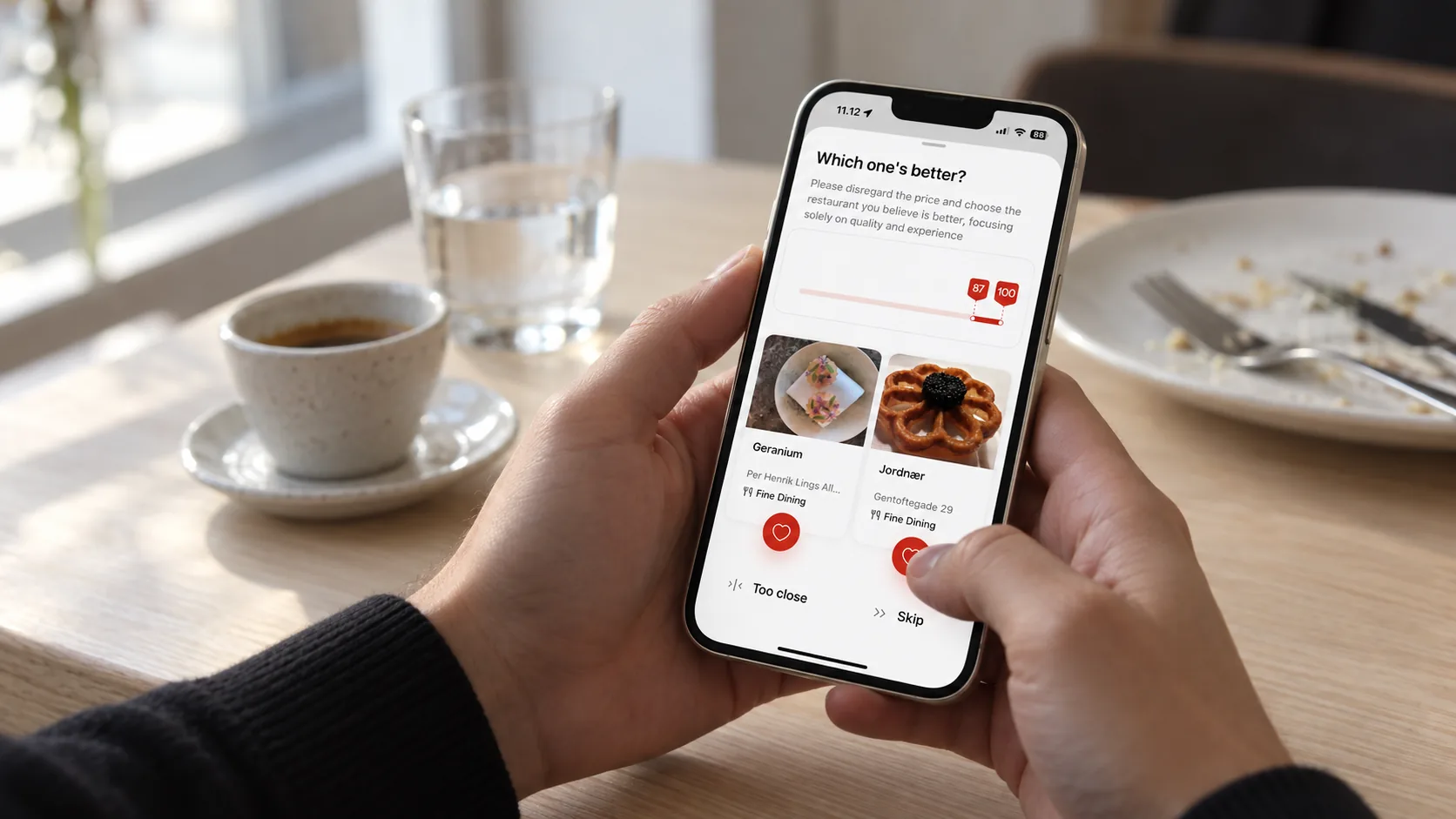
Vota is an independent restaurant rating app. Diners compare two restaurants they have visited and pick the better one; Vota turns those comparisons into a score from 1 to 100 for every restaurant. Vota has no ads, sponsorships or paid placements, and its only revenue comes from diners who subscribe to Vota Premium.
Vota was founded in Copenhagen in 2025 by Heini Zachariassen, the founder of the wine app Vivino. The app is free on iOS and Android and is available across Europe and the United States, with more than 3.5 million restaurants, cafés and bars in its database (September 2026).
What you’ll learn in this guide
- What Vota is
- Why restaurant ratings are broken
- How Vota’s rating works
- How to compare McDonald’s to a Michelin restaurant
- Why Vota is independent
- Vota vs Google Maps, Tripadvisor, Yelp and Michelin
- What you can do in the Vota app
- Where Vota is available
- Whether Vota is free
- Who is behind Vota
- How restaurants get on Vota
- Frequently asked questions
What is Vota?
Vota is a restaurant rating app and website built on one observation: people are better at comparing two restaurants than at grading one on a scale. Instead of asking for a star rating, Vota asks which of two restaurants a diner preferred. Every answer feeds a rating model that gives each restaurant a score from 1 to 100.
The app is on the App Store and Google Play, and restaurant and city scores are also on vota.org.
Vota describes its mission as “the Michelin Guide for the people”: quality ratings for every restaurant, from the kebab house on the corner to three-star fine dining, made by the people who actually eat there.
Vota is not a booking platform or a delivery service, and Vota does not sell anything to restaurants.
Why are restaurant ratings broken?
Restaurant ratings on the major platforms fail diners in three ways: the scores are compressed into a narrow band, the platforms are paid by the restaurants they rate, and reviews can be manipulated. Michelin solves the quality problem but covers a tiny fraction of restaurants. Vota exists to close those four gaps.
Star ratings compress. On a five-star scale most restaurants cluster between 4 and 5 stars, so a rating says little about which of two places is better. A study published in the Proceedings of the ACM on Human-Computer Interaction found that Google Maps ratings average 0.7 stars higher than Yelp ratings for the same restaurants, and that the two platforms’ top-ten lists for the same city have limited overlap. The rating depends as much on the platform as on the restaurant.
The platforms are paid by restaurants. Yelp reported $1.46 billion in net revenue for 2025, and $1.39 billion of it, about 95%, came from advertising sold to the businesses it lists. Tripadvisor sells sponsored placements to restaurants. Google sells ads inside Google Maps. On all three, the restaurant is the paying customer, not the diner.
Reviews can be manipulated. Tripadvisor removed 2.7 million fraudulent reviews in 2024, 8.7% of all reviews submitted, and 54% of that fraud was “review boosting” by owners, staff and people connected to the business. Google blocked or removed more than 240 million policy-violating reviews from Maps in 2024.
Michelin covers almost nothing. The Michelin Guide lists about 15,000 restaurants worldwide, out of roughly 15 million restaurants. That is about 0.1%. The guide is funded by Michelin and by tourism boards that pay to have their region inspected: Florida paid $150,000, South Carolina about $1 million over three years. Michelin’s inspectors are rigorous, but they will never visit your local pizzeria.
How does Vota’s rating work?
Vota rates restaurants with pairwise comparisons. A diner is shown two restaurants they have visited and picks the one they preferred. Each comparison feeds an Elo-style rating model, the same family of models used to rate chess players. Vota then maps the ratings onto a 1 to 100 scale. The higher a restaurant’s Vota score, the more often diners preferred it over the other restaurants they compared it with.
Why comparisons instead of stars? People are more reliable at relative judgments than absolute ones. Asked to grade a restaurant from 1 to 5, diners anchor on different standards, and most grades land on 4 or 5. Asked which of two restaurants they preferred, diners answer consistently, and the answers can be combined mathematically into a stable scale. This method, comparative judgement, is used in educational assessment, chess and sport because it turns many simple decisions into a reliable scale. A 2025 meta-analysis of 101 comparative-judgement datasets found a median scale reliability of 0.91.
How a comparison becomes a score
- A diner marks restaurants they have visited, in the app or by importing restaurant names from Google Maps.
- Vota shows two of them side by side and asks which was better. Diners judge the overall experience, not the category or the price: a great kebab shop can beat a mediocre fine-dining restaurant.
- Each answer feeds the rating model.
- Ratings are converted to a score from 1 to 100. A restaurant gets a score as soon as one diner has rated it.
- Every new comparison refines the score, so scores keep moving as more diners contribute.
Two numbers, one restaurant. Vota shows a global score and a personal rating. The global score, shown in red, combines every diner’s comparisons and is the same for everyone. The personal rating, shown in pink, is built from a diner’s own comparisons and is visible only to them. Recommendations draw on both: what the community rates highly, weighted by what the individual diner prefers.
Vota is a rating system, not a ranking. No editor places restaurants in order. Each restaurant has a score that reflects its own comparisons, and lists in the app are simply sorted by that score.
| Star ratings | Vota comparisons | |
|---|---|---|
| What the diner does | Grades one restaurant on a scale | Picks the better of two restaurants they have visited |
| Typical result | Most restaurants between 4 and 5 stars | Scores spread across 1 to 100 |
| What the number means | Average of grades made on different standards | How often diners preferred this restaurant over others |
| Effort per rating | Choose stars, write a review | One tap |
| Effect of one account | One review can add a five-star rating | One comparison moves a score a small step; it takes many diners to move it far |
How can you compare McDonald’s to a Michelin restaurant?
You can, and it is the easiest comparison on Vota. Vota asks one question: which restaurant was better, on quality and experience, with price left out. Take away what you paid, and for almost everyone a three-star Michelin restaurant beats McDonald’s on both. That answer is obvious, which is the point. The hard comparisons are the close ones.
The question comes up a lot, and it is a fair one. It feels wrong to put a burger chain and a tasting menu in the same sentence, because we normally judge them against different expectations: was it good for what it is, was it worth what it cost. Vota deliberately removes both filters. The comparison screen says so: “Please disregard the price and choose the restaurant you believe is better, focusing solely on quality and experience.”
Why one scale? Vota puts every restaurant in the world on the same 1 to 100 scale, from the kebab house to the three-star kitchen, because one scale is the only way a score can mean the same thing everywhere. The alternative is buckets: a 100 for fast food, a 100 for fine dining, a 100 for pizza, and fifty or a hundred more, each with its own top and bottom, none of them comparable. Then “the best place near me” has no answer, and neither does “is the new bistro better than my usual”. On one scale, a 72 is a 72 whether it is a pizzeria or a bistro.
What the score leaves out. A Vota score is not a verdict on value, and it does not tell you where to eat tonight. A 72 pizzeria can be the right choice over a 100 tasting menu every day of the week, because price, occasion and craving are yours to weigh. Vota keeps them out of the score so the score stays clean, and leaves the decision to you.
Most comparisons are close ones. The McDonald’s question describes the extreme case. As you rate more, Vota mostly pairs you with close calls, burgers against burgers, ramen against ramen, because that is where your answer tells the model the most. If two places are too close to call, tap Too close. If you cannot remember one well enough, tap Skip.
One scale, honest at both ends: the neighbourhood pizza place can be a 72, Geranium can be a 100, and both scores are true.
Why is Vota independent?
Vota is independent because no restaurant can pay Vota for anything. Vota sells no ads, accepts no sponsorships, and offers no paid placements or promoted listings. The only money Vota earns comes from diners who choose to subscribe to Vota Premium. The structure is deliberate: whoever pays is who the product serves, and Vota wants that to be the diner.
In practice that rules out everything the other platforms sell. Vota has no sales team calling restaurants, no “claim your listing” upsell, no promoted pins, no commission on bookings or deliveries, and no badge a restaurant can buy. A restaurant cannot get a higher position on the map or a better slot in a list by paying. The score a diner sees is the score the community produced, nothing else.
The rule is part of Vota’s business model, not only its marketing. Vota’s founder previously built Vivino, where 75 million users rate wines. Vota applies the same idea to restaurants with one addition: no revenue from the businesses being rated.
Vota vs Google Maps, Tripadvisor, Yelp and Michelin
Vota differs from Google Maps, Tripadvisor and Yelp in two ways: how the rating is made, and who pays for the platform. Those three collect star ratings and written reviews, and earn revenue from businesses. Vota collects comparisons and earns revenue only from diners. Vota differs from the Michelin Guide in scale: Michelin’s inspectors rate about 15,000 restaurants; Vota’s diners can rate any restaurant.
| Vota | Google Maps | Tripadvisor | Yelp | Michelin Guide | |
|---|---|---|---|---|---|
| How restaurants are rated | Head-to-head comparisons by diners | 1 to 5 stars and reviews by users | 1 to 5 bubbles and reviews by users | 1 to 5 stars and reviews by users | Anonymous professional inspectors |
| Scale | 1 to 100 | 1 to 5 | 1 to 5 | 1 to 5 | Stars, Bib Gourmand, Recommended |
| Who pays the platform | Diners, through an optional subscription | Advertisers, including businesses on Maps | Advertisers, hotels and restaurants | Advertisers; about 95% of 2025 revenue | Michelin, plus tourism boards that pay for coverage of their region |
| Ads or paid placement in results | None | Yes | Yes | Yes | No |
| Restaurants covered | Any restaurant | Nearly all | Millions | Millions | About 15,000 worldwide |
Vota does not replace Google Maps for finding an address or opening hours. It replaces the rating. Where the big platforms agree, Vota’s scale adds resolution: two restaurants that both show 4.5 stars on Google Maps can be 91 and 64 on Vota, because diners who have been to both have said which one they preferred.
What can you do in the Vota app?
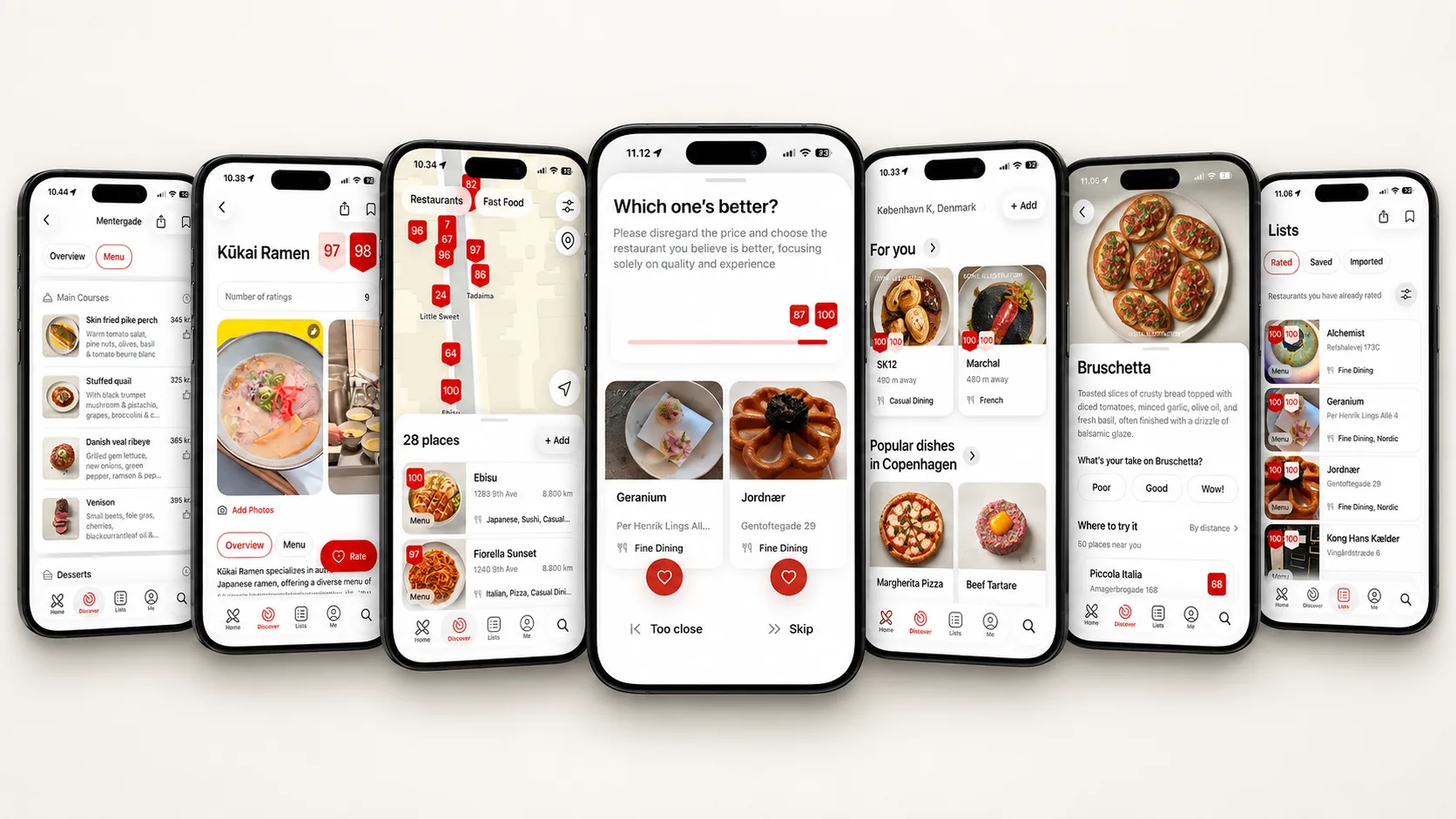
In the Vota app, diners rate restaurants by comparing them, get recommendations based on their own taste, browse a map where restaurants are sorted by Vota score, read menus before they go, and search for restaurants that serve a specific dish. All of the core features are free.
- Compare restaurants. Pick the better of two restaurants you have visited. Each comparison takes one tap.
- Import from Google Maps. Vota can import the names of the restaurants you have saved in Google Maps, nothing else, and turn them into your list of visited restaurants so you can start comparing straight away.
- Personal recommendations. Vota suggests restaurants based on your own comparisons and your location.
- Map and lists sorted by score. Restaurants near you, ordered by Vota score rather than by who paid.
- Menus. Vota collects restaurant menus so you can see what a place serves and what it costs before you go. Over 60% of Copenhagen’s restaurants have their menu on Vota (September 2026).
- Dish search. Search for a dish, from ramen to a spicy tuna sandwich, and see which restaurants near you serve it.
- Switch city. Browse any city in Vota’s database, at home or before a trip.
- Add a restaurant. If a place is missing, add it from the app.
- Photos and community. Add photos to restaurants and join other Vota users on the Vota Discord.
Where is Vota available?
Vota is available across Europe and the United States, with more than 3.5 million restaurants, cafés and bars in its database (September 2026). Diners can compare and rate restaurants in any city in the database, and every rated restaurant gets a score. Vota started in Copenhagen and grows city by city as diners compare.
The app is available in 16 languages: English, Danish, Swedish, Norwegian, German, French, Spanish, Italian, Dutch, Portuguese, Polish, Czech, Finnish, Romanian, Slovenian and Turkish.
Is Vota free?
Vota is free. Downloading the app, comparing restaurants, seeing scores, browsing the map and reading menus cost nothing, and there are no ads at any level. Vota Premium is an optional subscription for diners who want more, and it exists for one reason: so that diners, not restaurants, fund the service. That is the model that keeps Vota independent.
Premium adds features for people who travel and for people hunting a specific dish. The rating system, the scores and the map are the same for everyone, and Vota does not sell anything to restaurants, at any tier.
Who is behind Vota?
Vota is built by Vota ApS, a company founded in Copenhagen in 2025 by Heini Zachariassen. Zachariassen founded Vivino in 2010 and grew it into the world’s largest wine app, with more than 75 million users and $220 million raised, before starting Vota. Earlier, he co-founded the security software company BullGuard and served as its CEO.
“Restaurant ratings are broken. Michelin does quality right, but covers about 0.1% of all restaurants. Your local kebab shop deserves honest ratings too. I built Vivino to help people find great wine. Now I want to help them find great food.”
Heini Zachariassen, founder of Vota and Vivino
The Vota team is Heini Zachariassen (Founder), Anders Friis (Co-Founder, Product & Mobile App Engineer), Rasmus Agnvig (Co-Founder, Full-Stack Engineer), Kevin van Merkom (Full-Stack Engineer) and Staffan Ulmert (Head of Growth, Editor). Vota is headquartered in Copenhagen. Press enquiries go to support@vota.org.
How do restaurants get on Vota?
Most restaurants are already on Vota, and any restaurant owner can add a missing restaurant in the app in a minute. Listing is free, and there is nothing to buy: restaurants cannot pay to be listed, promoted or scored. A restaurant’s score comes only from comparisons made by diners who have visited it.
Restaurant owners who find incorrect information, such as an address, opening hours or a menu, can request a correction at support@vota.org. Owners cannot edit, remove or purchase ratings.
Frequently asked questions
Does Vota have ads or sponsored restaurants?
No. Vota has no ads, no sponsorships and no paid placements, and it does not sell anything to restaurants. Its only revenue is subscriptions paid by diners. No restaurant can pay to appear higher on the map or in a list.
How does Vota calculate a restaurant’s score?
Diners compare two restaurants they have visited and pick the better one. Each comparison feeds an Elo-style rating model, and Vota maps the ratings onto a 1 to 100 scale. A restaurant gets a score as soon as one diner has rated it, and the score keeps updating as more diners contribute.
What does a Vota score mean?
A Vota score is a number from 1 to 100. The higher the score, the more often diners preferred that restaurant over the other restaurants they compared it with. Scores are comparable across categories and price levels: a kebab shop with a score of 85 was preferred more consistently than a fine-dining restaurant with a score of 70.
How can you compare McDonald’s to a Michelin restaurant?
Easily. Vota asks which restaurant was better on quality and experience, with price left out, and on those two a Michelin restaurant wins. Vota uses one scale for every restaurant so that a score means the same thing everywhere, instead of separate scales for fast food, pizza and fine dining that cannot be compared.
Do I have to write reviews?
No. Rating on Vota is a comparison: say which of two restaurants you have visited you preferred. One comparison takes one tap.
Can a restaurant pay to improve its score?
No. A restaurant’s score comes only from comparisons made by diners who have visited it. Vota does not sell placements, badges, promoted listings or any other product to restaurants.
Which countries does Vota cover?
Vota is available across Europe and the United States, with more than 3.5 million restaurants, cafés and bars in its database (September 2026). Vota started in Copenhagen and grows city by city as diners compare.
How is Vota different from Google Maps?
Google Maps rates restaurants with 1 to 5 stars and written reviews from anyone, and earns revenue from advertisers, including the businesses it lists. Vota rates restaurants with head-to-head comparisons from diners who have visited them, on a 1 to 100 scale, and earns revenue only from diners.
Who owns Vota?
Vota is made by Vota ApS, a company based in Copenhagen, Denmark, founded in 2025 by Heini Zachariassen, the founder of Vivino.
What does “the Michelin Guide for the people” mean?
Michelin’s inspectors produce trustworthy quality ratings but cover about 15,000 restaurants worldwide, around 0.1% of all restaurants. Vota’s goal is that level of trust for every restaurant, produced by the diners who eat there instead of by a small group of inspectors.
How do I add a restaurant that is missing?
Search for it in the Vota app and choose to add it. Anyone can do this, including the restaurant’s owner. Once it is in the database, any diner who has visited it can include it in their comparisons.
Explore Vota in depth
| Page | What you’ll find |
|---|---|
| How Vota ratings work | The rating mechanics in full: the 1 to 100 scale, comparisons, red and pink scores, and where the numbers come from |
| Why I’m building Vota | The founder on why restaurant ratings stopped meaning anything, and how Vota is different |
| Copenhagen on Vota | Every rated restaurant in Copenhagen, sorted by Vota score, with filters by cuisine and district |
| The Vota team | Who builds Vota |
| Press | Background, materials and contact for journalists |
| Contact | Questions, corrections and support |
Download Vota
Vota is free on the App Store and Google Play. Compare the restaurants you know, and Vota will show you the ones you should know.